


EVs After the Oil Shock: Opportunity or Value Trap?
The Investment Question
Brent crude near $110 has revived a familiar question for investors: when gasoline becomes painful, do electric vehicles become inevitable? The answer is yes for adoption, but not automatically for returns.
Oil has remained above $100 per barrel amid the Iran conflict, with Reuters reporting Brent at $110.83 on May 18, 2026, even after a diplomatic pause eased immediate escalation fears. That is a meaningful shock relative to pre-war levels near $65. It raises household fuel costs, strengthens the total-cost-of-ownership case for EVs, and gives policymakers another reason to accelerate electrification.
Yet investors should separate industry growth from shareholder value. Global EV sales rose more than 20% in 2025 to 21 million units, reaching roughly one in four cars sold worldwide, according to the International Energy Agency. That is structural growth. But it is also uneven, subsidy-sensitive, and increasingly defined by battery economics, not just consumer demand.
“High oil prices improve the EV adoption story, but battery cost leadership determines who captures the profit pool.”
Growth Is Real, But Geography Matters
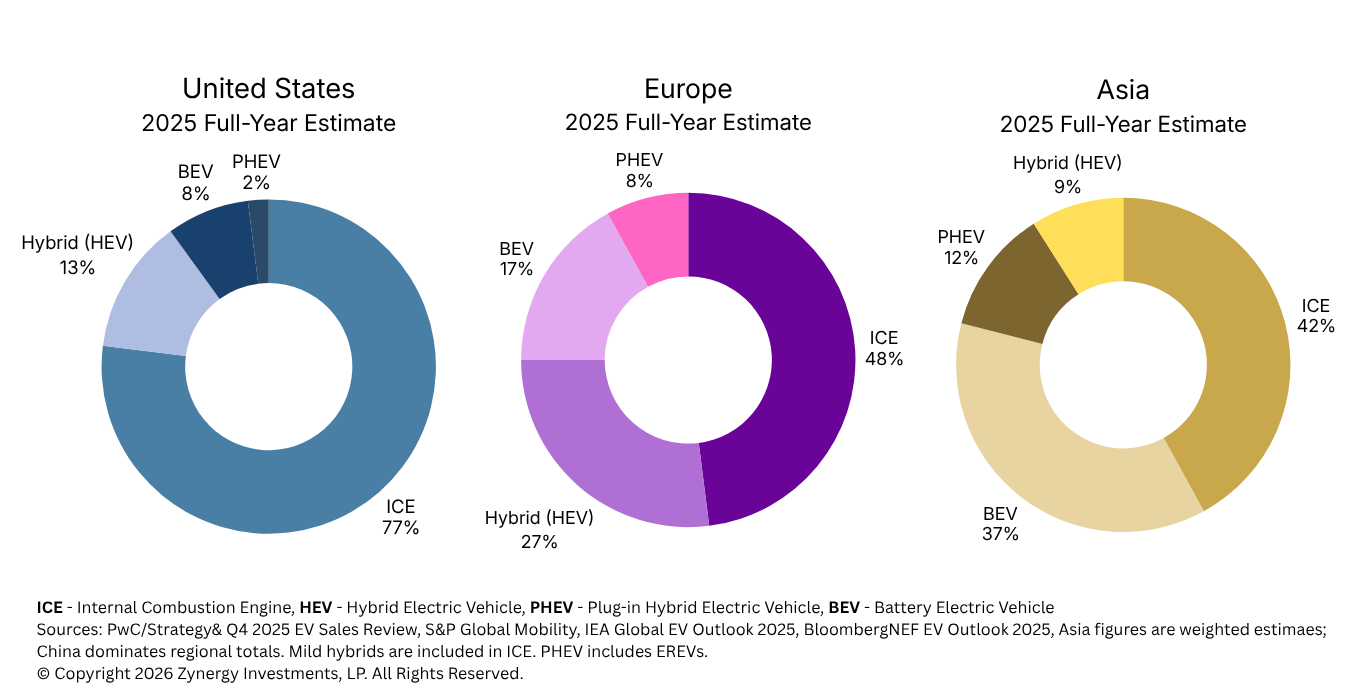
The global EV market is not one market. It is three markets moving at different speeds.
China and Europe remain the growth engines. Benchmark Mineral Intelligence reported that global EV sales reached about 20.7 million units in 2025, up 20% year over year, while Europe grew 33%. PwC’s Strategy& also noted that the top five European markets saw BEV sales rise 41% year over year in the fourth quarter of 2025, with BEVs reaching 20% of sales in those markets.
The United States is more complicated. Reuters reported that North American EV registrations fell 28% year over year in April 2026, partly tied to the expiration of U.S. tax credits and softer regulation. That matters because U.S. EV adoption has relied heavily on incentives and premium buyers. When subsidies fade, price gaps become harder to ignore.
Europe offers the opposite case. Germany introduced a means-tested EV grant in 2026 of up to €6,000, while BEVs registered from 2026 through 2030 are eligible for a 10-year vehicle tax exemption. Higher gasoline prices also make the EV equation more compelling for European consumers than for many U.S. buyers.
China is in a category of its own. The IEA noted that China sold more than 11 million electric cars in 2024, more than total global EV sales just two years earlier. Scale is not a footnote. It is the moat.
The Battery Is the Business Model
The industry’s center of gravity has shifted from brand to battery.
Goldman Sachs Research forecast that average battery prices could fall toward $80 per kilowatt-hour by 2026, a level that could bring unsubsidized EV ownership-cost parity with gasoline vehicles in the United States. BloombergNEF data showed China’s average battery pack prices at $84 per kilowatt-hour in 2025, while North America was 44% higher and Europe 56% higher.
That gap explains much of the East versus West performance divide. Chinese manufacturers have embraced LFP batteries, which are cheaper, safer, and longer-lasting, though less energy dense than nickel-manganese-cobalt batteries. McKinsey expects LFP to remain the cost leader because of lower-cost materials and higher thermal stability, anchoring mass-market EVs and battery storage.
Western EV manufacturers, by contrast, have often leaned into premium vehicles using higher-density chemistries and more expensive platforms. Tesla remains the exception in scale, but Rivian, Lucid, and Polestar still face a difficult equation: luxury positioning, capital intensity, and competition from lower-cost Asian producers.
China’s Advantage Is Structural, Not Cyclical
For investors, China’s advantage is not just lower labor cost. It is ecosystem depth.
Chinese EV leaders benefit from vertical integration across batteries, power electronics, semiconductors, motors, software, and assembly. They also operate inside the world’s most competitive EV market, where price pressure forces efficiency faster than in protected markets.
That competition creates a paradox. It makes Chinese companies more formidable globally, but it compresses margins at home. The best operators may compound scale, while weaker players struggle in a market where aggressive pricing can destroy profitability.
This is why a simple “buy EV growth” strategy is insufficient. Over the last three years, an equal-weighted basket of major Asian EV companies, including BYD, Li Auto, Seres Group, NIO, XPeng, Leapmotor, Lotus, and VinFast, has materially outperformed a Western EV basket including Tesla, Rivian, Lucid, and Polestar. Based on the supplied basket comparison, the gap is roughly 80 percentage points, with Eastern producers up nearly 50% and Western producers down about 30%.
That performance tells a story. Investors have rewarded scale, manufacturing efficiency, and cost leadership more than aspirational design.
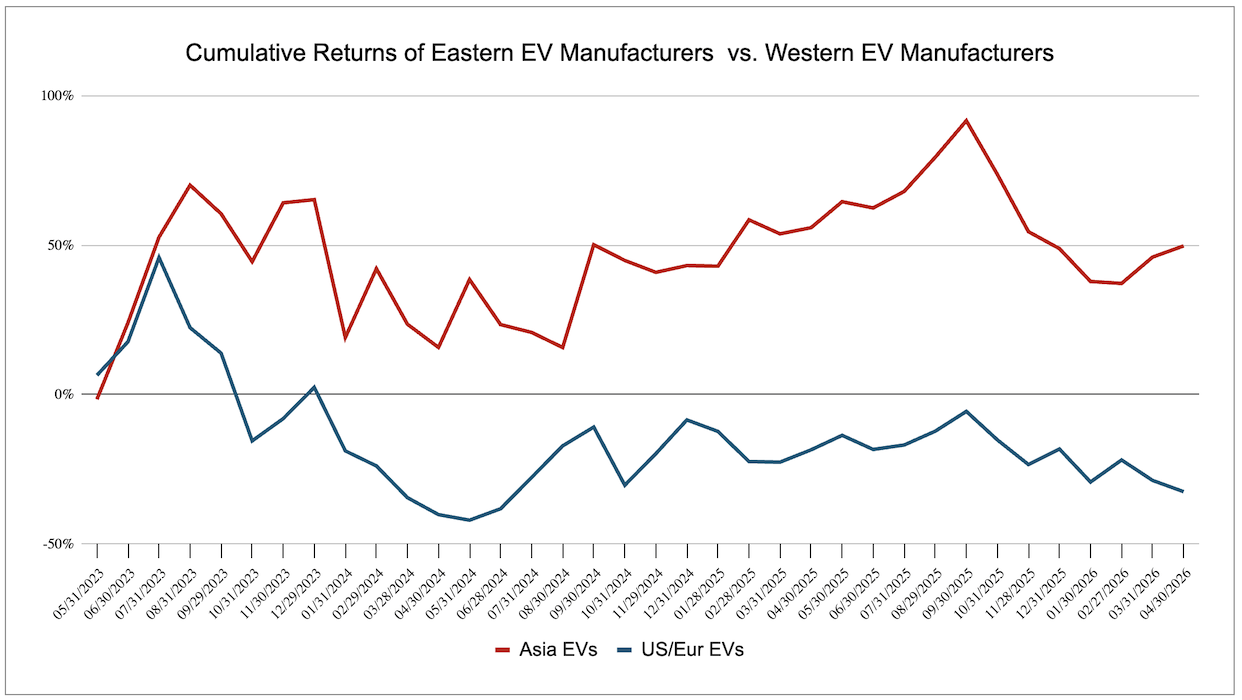
Source: Zynergy, FactSet as of 04/30/2026
Eastern EV Manufacturers include BYD, Li Auto, Seres Group, NIO, Xpeng, Leapmotor, Lotus, and VinFast
Western EV Manufacturers include Tesla, Rivian, Lucid Group, and Polestar
Manufacturers of Commercial BEVs and those with significant sales in ICE vehicles were excluded.
U.S. Automakers Are Responding, But With a Lag
Ford and GM understand the problem. They are moving toward LFP.
Ford’s BlueOval Battery Park Michigan is slated to begin LFP battery production in 2026 using CATL-licensed technology, while Ford has also linked those batteries to a future midsize electric truck. GM and LG Energy Solution’s Ultium Cells venture announced plans to convert the Spring Hill, Tennessee plant for LFP production, with commercial output expected by late 2027.
These moves are strategically sound. They also confirm how far the U.S. supply chain must travel. China is already operating at scale, while the U.S. is still localizing cost-competitive battery chemistry.
Investment Implications for Private Wealth
For high-net-worth investors, family offices, and finance professionals, the current setup argues for selective exposure, not broad enthusiasm.
- High oil prices support EV demand, especially in Europe and emerging markets.
- China remains the strongest public-market hunting ground, but margin pressure is real.
- Battery producers and battery materials may offer cleaner exposure than automakers.
- Rare earth and critical minerals exposure, including nickel, manganese, and cobalt, can diversify the EV thesis, though commodity volatility must be managed.
- Hybrid public-private strategies may be attractive where investors can access battery technology, charging infrastructure, fleet electrification, grid software, or AI-enabled energy optimization.
The AI angle is becoming more relevant. EV value creation increasingly depends on software, autonomous systems, battery management, manufacturing automation, and energy trading. The next winning platform may not be the company with the sleekest vehicle. It may be the company that uses data and AI to lower lifetime cost, improve charging efficiency, and manage battery degradation at fleet scale.
Zynergy View: Cautious, But Not Dismissive
Elevated oil prices make EV adoption more attractive, but they do not erase valuation risk, subsidy risk, or margin pressure. The strongest case today is not simply “EVs will grow.” That is already evident. The stronger investment question is: who converts growth into durable cash flow?
Our preference would lean toward cost-advantaged Asian manufacturers and battery-linked businesses rather than unprofitable Western pure plays. Still, China exposure requires discipline. Competition is intense, policy can shift quickly, and margins may remain thinner than headline unit growth suggests.
The better posture is selective, research-driven, and patient. EVs are not a trade on oil alone. They are a long-cycle industrial transformation shaped by batteries, software, policy, and capital discipline.
Join the conversation with Zynergy Insights, where innovation meets disciplined investing.