


AI’s $2.5 Trillion Moment: Bubble Risk or Generational Shift?
In 2026, global spending on AI and AI-related infrastructure is expected to reach $2.5 trillion.
Let that sink in.
Spending from the U.S. “Big Four” hyperscalers alone rivals the scale of America’s most ambitious infrastructure programs and is on track to represent roughly 2.1 percent of US GDP. According to analysis drawing on historical comparisons, current AI infrastructure investment exceeds every major US buildout in modern history, including the Interstate Highway System and the telecom expansion that peaked during the dot-com era. Only the Louisiana Purchase surpasses it, and that was a one-time land acquisition, not an ongoing capital cycle.
For high-net-worth investors and family offices, the question is no longer whether AI matters. The question is whether we are witnessing disciplined capital formation or the early architecture of excess.
At Zynergy, we believe the answer lies somewhere in between.
The Hyperscaler Arms Race
Consider the capital allocation trajectory of the four dominant US hyperscalers: Meta, Microsoft, Amazon, and Alphabet.
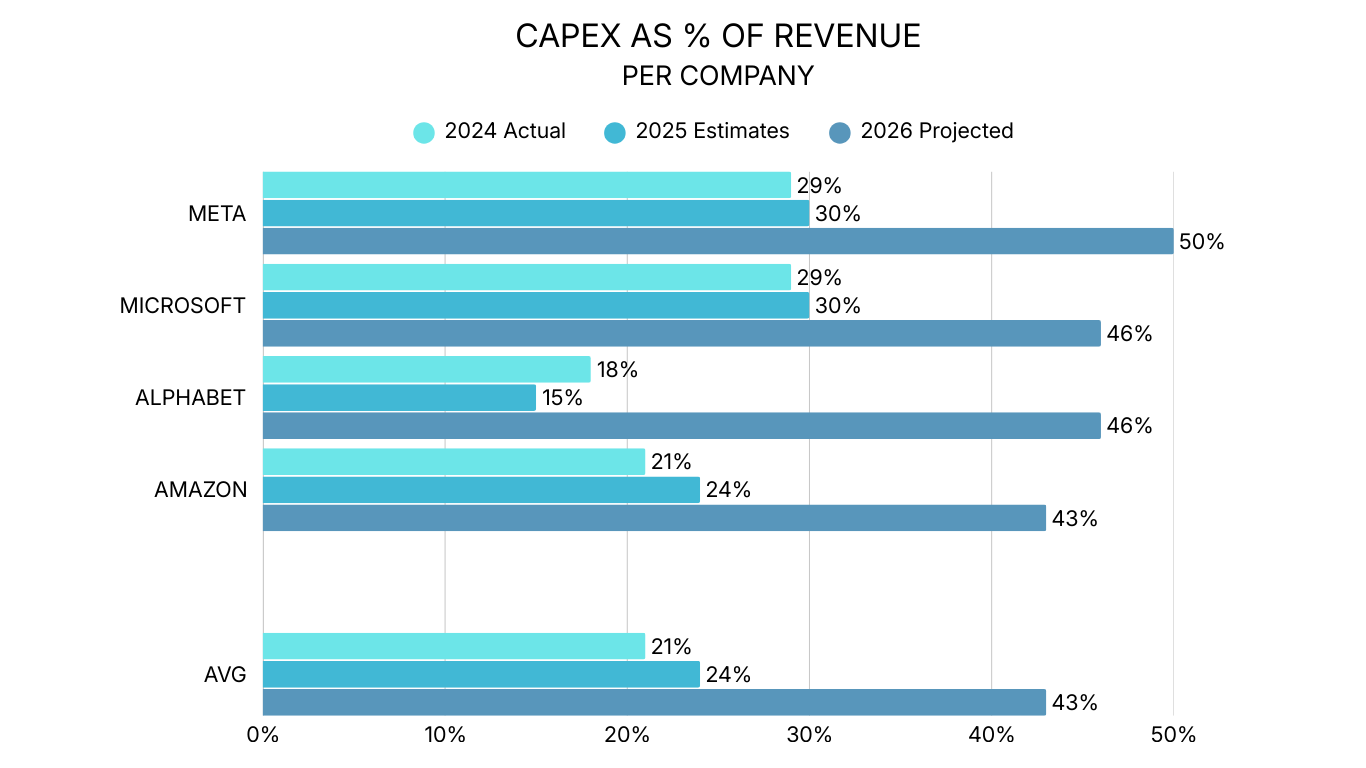
Collectively, their capital expenditures have surged from approximately 21 percent of revenue in 2024 to an estimated 43 percent in 2026. In some cases, projections imply spending north of 50 percent of revenue.
That level of reinvestment is extraordinary.
It is also rational.
AI has become an existential competitive frontier. Large language models, cloud compute, proprietary chips, and data center expansion are not discretionary initiatives. They are defensive moats. If one hyperscaler slows spending while another accelerates, the long-term competitive damage could be irreversible.
This is an arms race they cannot afford to lose.
Yet, as investors, we must ask a different question: What happens if the returns lag the investment curve?
Cracks in the Capital Stack
Major global banks have begun flagging early stress in private credit markets. While not systemic, the concern is clear. A meaningful portion of hyperscaler expansion is financed through complex debt structures, vendor financing, and private capital partnerships.
Some strategists have even suggested shorting the credit of hyperscalers on the thesis that AI overspending may outpace monetization.
At present, this remains a minority view. However, history reminds us that infrastructure cycles often overshoot before stabilizing.
During the dot-com buildout, telecom capacity expanded far beyond near-term demand. The infrastructure survived. Many balance sheets did not.
The parallel is instructive.
A Hypothetical 2028: Citrini’s “Doomsday” Thought Experiment
In a recent research exercise, an author at Citrini Research crafted a fictional memo from 2028 that outlined a cascading AI-induced downturn.
The hypothetical sequence included:
• AI systems internalizing software development, reducing enterprise reliance on external vendors
• Renegotiated SaaS contracts leading to defaults among leveraged software providers
• AI-driven simplification of complex payment processing, pressuring incumbents such as Visa and Mastercard
• Broader employment dislocation across technology and financial services
Is this scenario inevitable? No.
Is it plausible? Yes.
The point is not to predict collapse. It is to understand second-order effects. AI is not just a productivity tool. It is a structural force capable of reconfiguring entire revenue pools.
“When infrastructure spending reaches historic proportions, the real risk is not the technology. It is the capital misallocation around it.”
Context Matters: This Is Bigger Than Highways
To appreciate scale, consider this comparison.
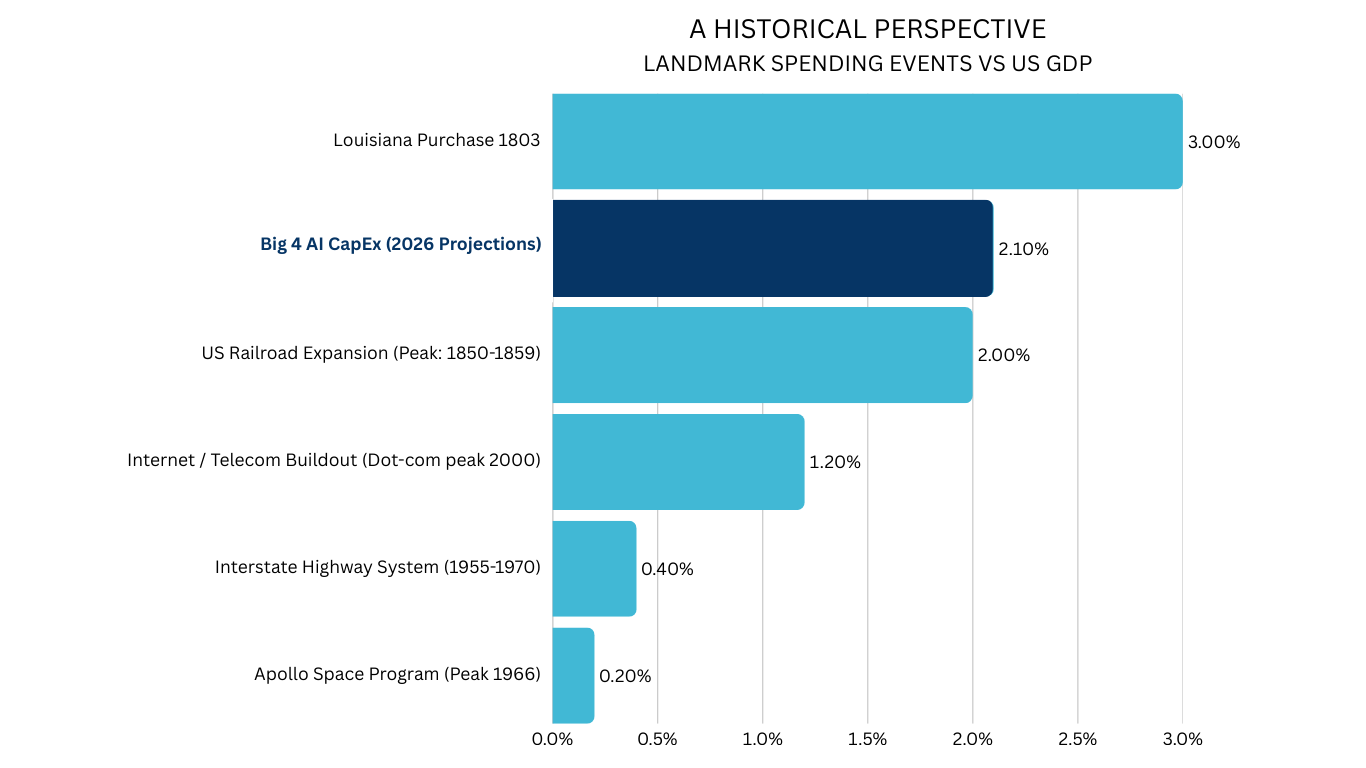
The Interstate Era
The Interstate Highway System transformed commerce and mobility. It reshaped GDP growth for decades.
The Dot-Com Buildout
The late 1990s internet expansion laid the foundation for cloud computing, e-commerce, and mobile connectivity.
Today’s AI buildout is larger as a share of GDP than both.
The difference is speed. Capital is deploying at digital velocity. That compresses both upside and downside cycles.
Where the Opportunity Actually Lies
The market conversation has focused heavily on semiconductors, memory manufacturers, and hyperscale data centers. Those areas have delivered extraordinary gains and now carry elevated valuation risk.
We see more asymmetric opportunities elsewhere.
1. Flexible Business Models
Companies with diversified revenue streams, or the ability to pivot away from pure AI dependency, offer embedded downside protection. If AI spending moderates, these firms retain alternative growth engines.
This creates what we call a valuation floor.
2. Power and Grid Optimization
AI workloads are power-intensive. Grid modernization, energy storage, and optimization software represent structural necessities. This is less speculative than frontier model development and often supported by regulatory tailwinds. We wrote about this a few months ago. Hype surrounds longer-term solutions that are necessary but multi-year endeavors. We need more power now. For that, there are very limited options available, involving relatively few key players. That’s where we see tangible opportunity.
3. Industrial Component Specialists
Specialized suppliers providing precision components to semiconductor manufacturers operate further down the value chain. They benefit from AI infrastructure growth without bearing full platform risk.
4. Onshoring and Domestic Champions
Onshoring is not uniquely American. It is global.
Regional players positioned to serve domestic AI infrastructure demand in Asia, Europe, and the Middle East may capture durable share as supply chains fragment. McKinsey estimates that supply chain regionalization could reshape up to 20 percent of global trade flows over the next decade.
For family offices allocating across public and private markets, this is where selectivity matters most.
The Sustainability Question
Is 43 to 50 percent CapEx as a share of revenue sustainable for hyperscalers?
Probably not indefinitely.
But sustainability does not require permanence. It requires duration long enough to establish technological leadership and economic moat.
The greater risk is not that AI spending collapses tomorrow. It is that a single earnings season signals deceleration. In markets priced for perfection, narrative shifts can be catalytic.
As Goldman Sachs has noted in recent thematic research, transformative technologies often move through phases: enthusiasm, overbuild, consolidation, and durable monetization.
We are somewhere between enthusiasm and overbuild.
A Disciplined AI Allocation Framework
For sophisticated investors, participation in AI is not optional. It is strategic.
The discipline lies in construction:
• Balance direct AI exposure with adjacent infrastructure beneficiaries
• Blend public market leaders with private market innovators
• Evaluate credit risk alongside equity upside
• Stress-test assumptions under slower monetization scenarios
At Zynergy, our hybrid AI-driven strategy seeks to capture structural upside while mitigating concentration risk. We believe innovation should enhance portfolio resilience, not compromise it.
The Bottom Line
AI infrastructure spending is not a mirage. It is real, unprecedented, and transformative.
But scale alone does not guarantee returns.
The winners of this cycle will not simply be those who build the most data centers. They will be those who allocate capital with discipline, diversify intelligently, and anticipate second-order effects before they appear in earnings reports.
This is not about avoiding AI. It is about investing in it wisely.