

The Diversification Illusion
The ten largest companies in the S&P 500 now make up about 41% of the index’s market value but only about 36% of its earnings, according to J.P. Morgan Asset Management’s Guide to the Markets (data as of September 30, 2026). If you own the index, you may own a concentrated bet that happens to wear a diversified label.
Most investors we speak with fall into one of two camps. The first is heavily overweight megacaps, often without meaning to be, through index funds, growth managers and direct holdings that all point back to the same handful of names. The second owns smaller, less familiar companies but holds them the way you might hold a lottery ticket: small positions, a thin thesis, and a quick exit at the first drawdown.
Neither camp has what matters most in a crowded market. That is conviction in something the consensus has not yet priced.
Our view is that the next decade of technology growth will come less from the companies building AI and more from the companies AI cannot scale without. Every big story has a choke point, and choke points are where scarcity, pricing power and mispricing tend to live.
Two themes make the case vividly: humanoid robotics, which we believe reaches a commercial inflection in 2027, and energy efficiency, the slower but far larger contest to power everything AI wants to do.
Follow the Bottleneck, Not the Headline
Headlines follow the companies that sell the finished product. Returns often follow the companies that sell the scarce input. During the dot-com buildout, the network was the story. Today, the large language model is the story. In both cases, the parts that could not be produced fast enough held real pricing power.
The opportunity set has also moved. The number of U.S. listed companies fell from just over 8,000 in 1996 to roughly 4,600 by 2022, according to Sherwood News. Many of the most interesting builders now stay private far longer. A view limited to public markets sees only part of the picture, and a view limited to megacaps sees even less.
We use a simple screen to find bottlenecks worth studying:
- Scarcity: demand is growing faster than capacity can be added, often because of specialized materials, skills or permits.
- Specificity: the input is hard to substitute, so customers pay for reliability rather than shop on price.
- Neglect: sell-side coverage is thin, and the company rarely appears in thematic ETFs.
- Access: the exposure exists in public small and mid caps, private companies, or both.
“Concentration is not the same as conviction. Owning what everyone owns is a decision too, just an unexamined one.”
Run that screen across today’s AI economy and two areas keep surfacing.
Theme 1: Humanoids in 2027, and Why the Money Is in the Joints
Why 2027 matters
Forecasts for humanoid robots are rising quickly. In September 2026, Goldman Sachs raised its 2030 shipment estimate to 890,000 units from 256,000, and now expects 6.5 million units a year by 2035, a market of roughly $138 billion (24/7 Wall St.). Over a longer horizon, Morgan Stanley Research sees more than 1 billion humanoids in use by 2050, supporting a $5 trillion market (Morgan Stanley). These are third-party forecasts, and forecasts can be wrong.

The economics are already shifting. China’s Unitree sold 5,500 humanoids in 2025, roughly a third of global sales, while its average selling price fell from about $85,000 in 2023 to about $25,000. It still earned gross margins near 60% (Rest of World). Private capital has noticed too. Venture funding for humanoids jumped from $1.5 billion in 2024 to $6.1 billion in 2025, according to PitchBook.
We believe 2027 is the year pilots start becoming purchase orders. As units move from the hundreds to the tens of thousands, supply chains, not demos, start to decide who wins.
The choke point is the joint
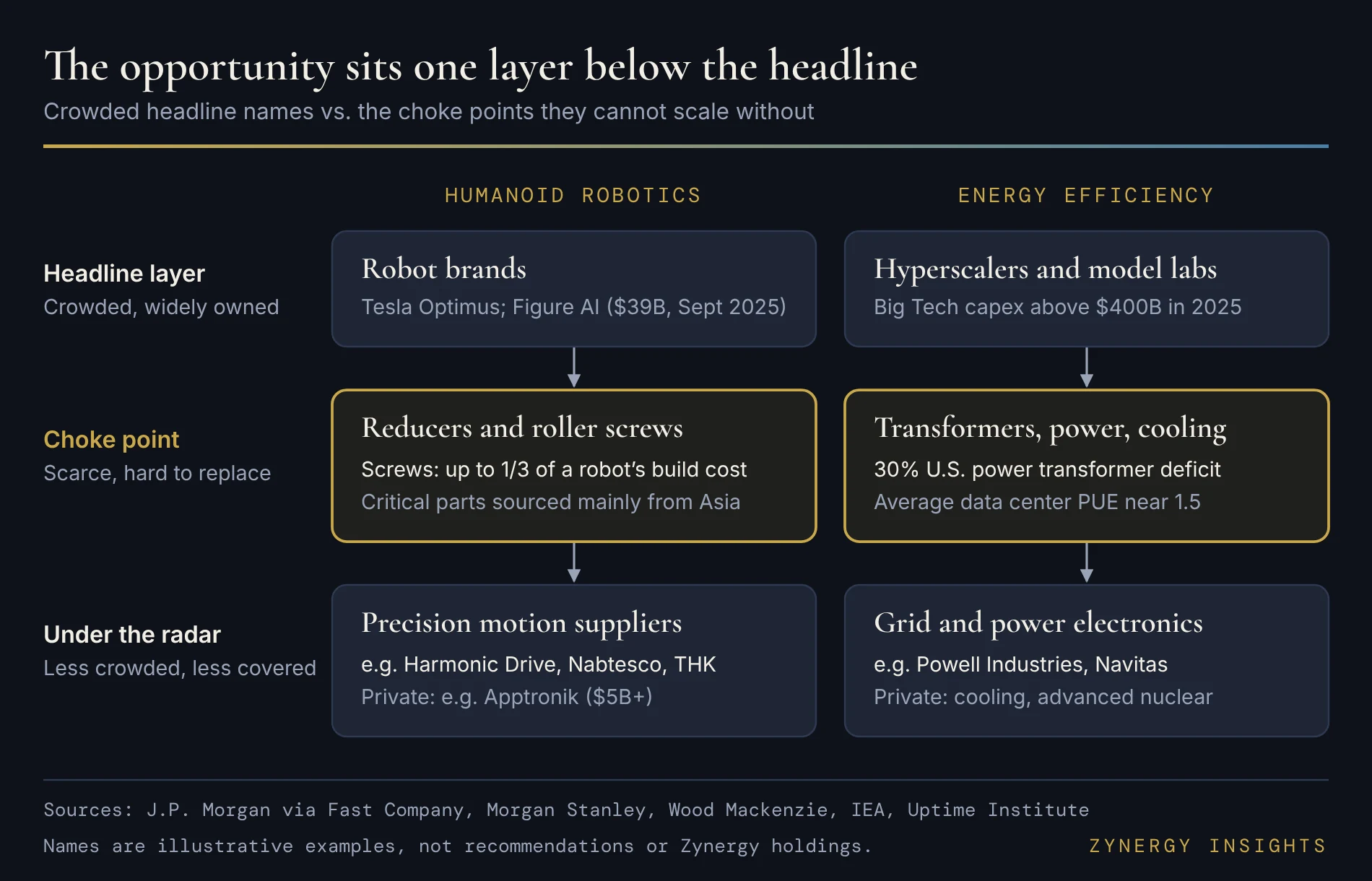
A humanoid can use 40 or more planetary roller screws, the precision parts that turn motor spin into controlled movement. Screws alone can account for up to a third of a robot’s construction cost, and a single screw can cost $1,350 to $2,700, according to J.P. Morgan data cited by Fast Company. Morgan Stanley adds that nearly every robot developer still relies on critical parts from China and other parts of Asia.
That combination of high cost, tight tolerances and concentrated supply is the definition of a bottleneck. It is also where the market is starting to pay attention. Japan’s Harmonic Drive Systems, a leader in strain wave gearing, reported orders up 56% year over year in its first fiscal quarter (April to June 2026) and raised its full-year operating profit forecast by ¥2.3 billion to ¥8.5 billion, citing demand from semiconductor equipment and robots (Investing.com).
Where the bottleneck shows up
The examples below illustrate the theme. They are not recommendations, and they do not represent Zynergy’s holdings.
- Public components: precision reducer and motion-control makers such as Harmonic Drive Systems, Nabtesco and THK, which sell to many robot builders rather than depending on one.
- Test and automation: companies like Teradyne, whose robotics and test businesses stand to see more demand as volumes scale.
- Private builders: Apptronik raised $520 million in February 2026 at a valuation reported above $5 billion, with Google and Mercedes-Benz among its investors (TechCrunch). Figure AI was valued at $39 billion in its September 2025 funding round (Yahoo Finance). Two companies in the same race can carry very different prices, which is why valuation matters as much as technology.
“In a gold rush, the robot gets the headline. The gearbox gets the margin.”
Theme 2: Energy Efficiency, Where the Watt Becomes the Unit of Value
The math has changed
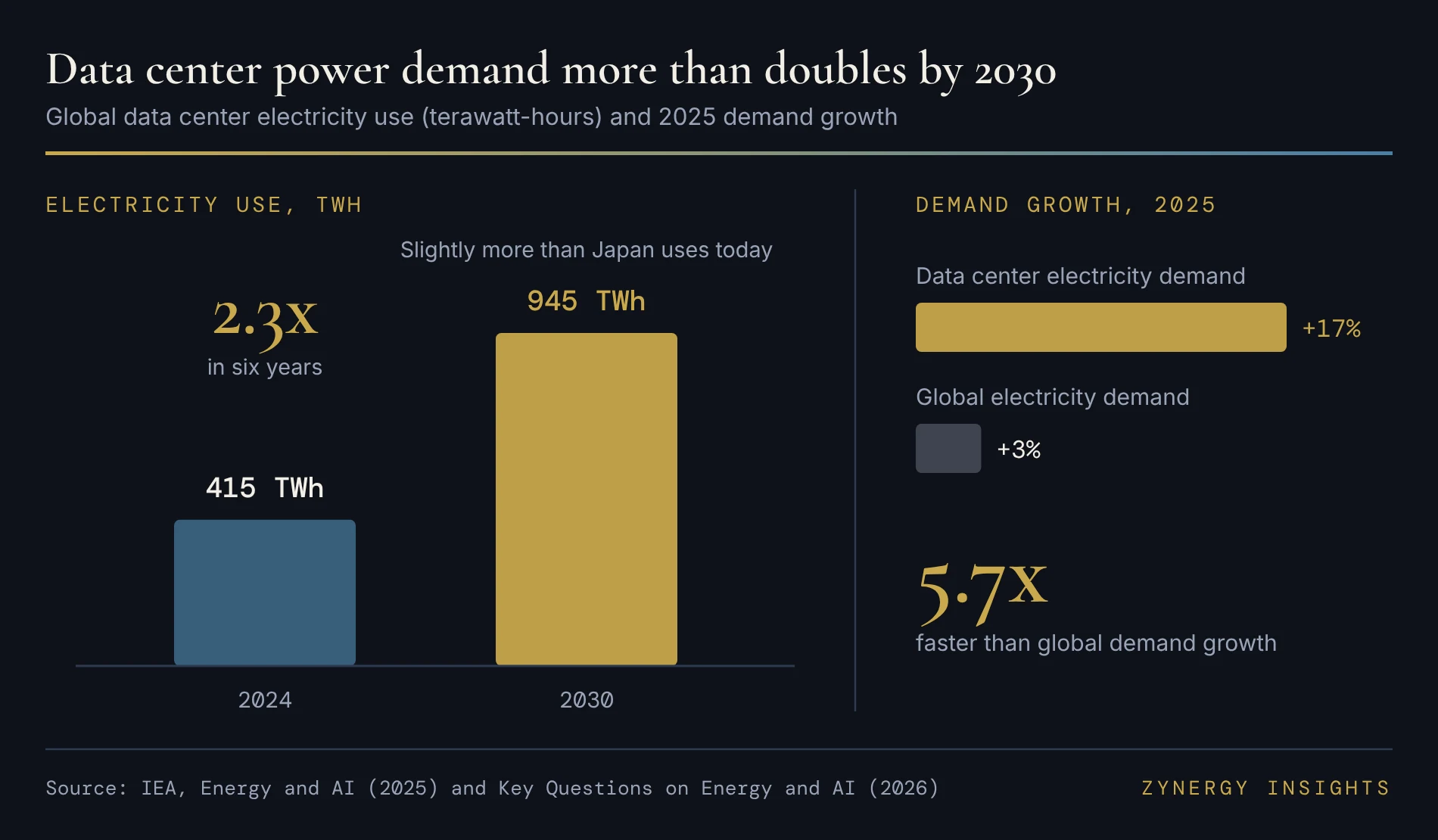
Anthropic CEO Dario Amodei has described advanced AI as “a country of geniuses in a datacenter” (Machines of Loving Grace). Countries need power. The International Energy Agency estimates data centers used about 415 terawatt-hours in 2024 and will use around 945 TWh by 2030, slightly more than Japan consumes today (IEA).
The pace is faster than many expected. Data center electricity demand rose 17% in 2025, while global demand grew about 3%. Five of the largest technology companies spent more than $400 billion on capital expenditure in 2025, and that figure is projected to rise another 75% in 2026 (IEA, April 2026).
Here is the part many investors miss. Every watt saved is capacity that does not need to be permitted, built or connected. In a power-constrained world, efficiency is not a green add-on. It is growth.
The choke points
- Transformers: the U.S. faces a 30% supply deficit in power transformers in 2025, and about 80% of supply is imported, according to Wood Mackenzie (pv magazine).
- Overhead: the average data center still runs a power usage effectiveness near 1.5, roughly 50 cents of overhead for cooling and conversion on every dollar of compute power. Leading hyperscalers operate near 1.1 (mGrid, citing Uptime Institute).
- Firm power: conditional agreements between data center operators and small modular reactor projects grew from 25 gigawatts at the end of 2024 to 45 GW by April 2026, according to the IEA.
Where the bottleneck shows up
Again, these are illustrations, not recommendations or a list of holdings.
- Grid and switchgear specialists: Powell Industries, a Houston maker of electrical distribution equipment, reported a $1.8 billion backlog (up 33%) and new orders up 97% in its fiscal Q2 2026 (January to March 2026). It then announced a data center order above $400 million, the largest in its history (Powell Industries).
- Power semiconductors: gallium nitride and silicon carbide suppliers such as Navitas, which NVIDIA selected to help develop its 800-volt power architecture for AI data centers.
- Cooling and private innovators: liquid cooling, heat reuse and advanced nuclear developers, many of which are still private.
“In a power-constrained economy, the cheapest megawatt is the one you never have to build.”
How We Turn Low Conviction into High Conviction
Owning an obscure name is easy. Owning it with enough confidence to hold through volatility is the hard part. These are the principles we work by. They are general ideas, not advice for any individual portfolio.
- Map the bottleneck first, then the company. Start with the scarce input and work outward to who controls it. The ticker is the last step, not the first.
- Look for the toll road, not the race car. Component and infrastructure suppliers sell to many competitors, so the thesis doesn’t depend on picking the winning robot or the winning model.
- Consider public and private markets together. Listed small and mid caps offer flexibility. Private companies can offer earlier exposure to businesses that may not list for years, with less liquidity and more risk.
- Let research, not familiarity, drive conviction. A company studied deeply deserves more attention than one known only by its brand.
- Set the disconfirming evidence in advance. Write down what would prove the thesis wrong, such as pricing pressure, a cheaper substitute or a policy shift, and revisit it every quarter.
The risks are real. Rising volumes can bring pricing pressure for component makers. Morgan Stanley’s Adam Jonas expects humanoid adoption to be “relatively slow until the mid-2030s, accelerating in the late 2030s and 2040s.” Supply chains concentrated in China carry trade and policy risk. Conviction is not certainty. It is a clear thesis paired with a disciplined plan for being wrong.
What It Means for You
The index may keep rewarding the megacaps for some time. We are not suggesting anyone abandon them. We are suggesting they not be mistaken for diversification, and that smaller, well-researched positions deserve more than afterthought status.
The humanoid buildout and the race for energy efficiency are two of the clearest places where scarcity, neglect and long-term demand meet. The companies at those choke points are rarely household names. That is exactly why they deserve a closer look.
For more of our research on AI, technology and innovation, explore Zynergy Insights.
Important information. This article is for informational purposes only and reflects the views of Zynergy Investments, LP as of October 2026, which may change without notice. It is not investment, legal or tax advice, a recommendation, or an offer to buy or sell any security or interest in any fund. Companies named are illustrative examples, do not represent all or any of Zynergy’s holdings, and should not be assumed to be profitable. Zynergy and its affiliates may hold positions in securities discussed and may buy or sell them at any time. Forecasts and estimates are those of the third parties cited, are not guaranteed and may not occur. Third-party data is believed reliable but has not been independently verified. Investing involves substantial risk, including possible loss of principal. Past performance is not indicative of, and is no guarantee of, future results.
About the authors

James Zimbardi
Founder, Chief Executive Officer & General Partner
Founder and CEO of Zynergy and an MIT Sloan Fellow in Innovation & Global Leadership. A business builder and innovation expert who turns where technology is heading into ventures built to last.

Larry McKay, CFA, CTFA
Chief Investment Officer & General Partner
Chief Investment Officer of Zynergy, a CFA charterholder, CTFA and MIT Sloan MBA. Leads the firm’s research, trading and fund management across technology and financial markets.