


The 2026 IPO Market Is Back, but Selectivity Matters More Than Ever
The IPO market has reopened, but it has not reopened evenly. That distinction matters.
In early 2026, investors saw one of the strongest starts for U.S. IPO activity since 2021. PwC reported that 22 traditional IPOs raised more than $9.4 billion in the first quarter, compared with 15 IPOs raising roughly $7.9 billion during the same period last year. The headline is encouraging. The deeper story is more important: public markets are rewarding scale, scarcity, and credible exposure to artificial intelligence infrastructure, while still punishing weak business models and inflated valuations.
The IPO window is open, but for high-net-worth investors, family offices, and institutional allocators, the opportunity is not simply to buy the next high-profile listing. The opportunity is to separate durable platforms from momentum trades.
A Strong Earnings Backdrop Is Supporting Risk Appetite
The IPO revival is taking place against a supportive earnings backdrop. FactSet reported that the S&P 500’s Q1 2026 net profit margin reached 14.8%, the highest level since FactSet began tracking the metric in 2009. Its latest earnings update also showed that Q2 margins were expected to remain elevated at 14.2%, still above the five-year average of 12.3%.
That margin strength helps explain why equity markets have absorbed high valuations better than many expected. The S&P 500 is up 10.2% year to date through June 30, with investors focused on AI spending, earnings growth, and the second-half IPO pipeline.
The distinction is critical. A market driven by earnings expansion is different from a market driven only by multiple expansion. In our view, Q1 earnings growth outpaced price appreciation, suggesting that fundamentals, not just enthusiasm, have supported much of the recent move.
For investors, that creates a constructive but selective environment. Strong index-level profitability can support new issuance. It does not automatically validate every IPO price.
The IPO Market Has Shifted From Quantity to Concentration
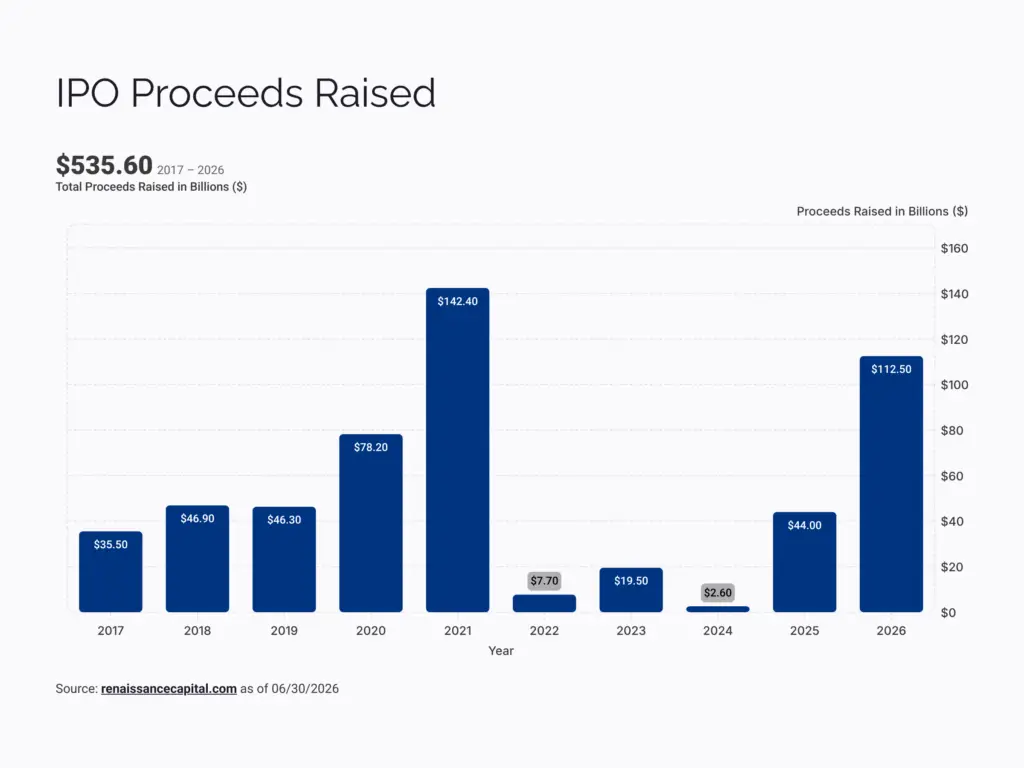
The 2026 IPO market is not defined by a flood of small offerings. It is being shaped by fewer, larger, and more strategically significant deals.
IPO proceeds are up roughly 625% year over year, while the number of deals is down about 19% over the same time period. That means capital formation is concentrating in mega-deals, especially in AI infrastructure, space, drones, and defense.
This pattern fits the broader capital cycle. AI isn’t just a software-only theme. It’s an infrastructure buildout that touches data centers, power systems, chips, satellites, defense networks, and automation. McKinsey has described the global data center race as a multi-trillion-dollar buildout, with capital pouring into infrastructure but constrained by power, thermal equipment, and execution bottlenecks.
That matters because many of the most anticipated IPOs are not traditional growth companies. They are infrastructure platforms.
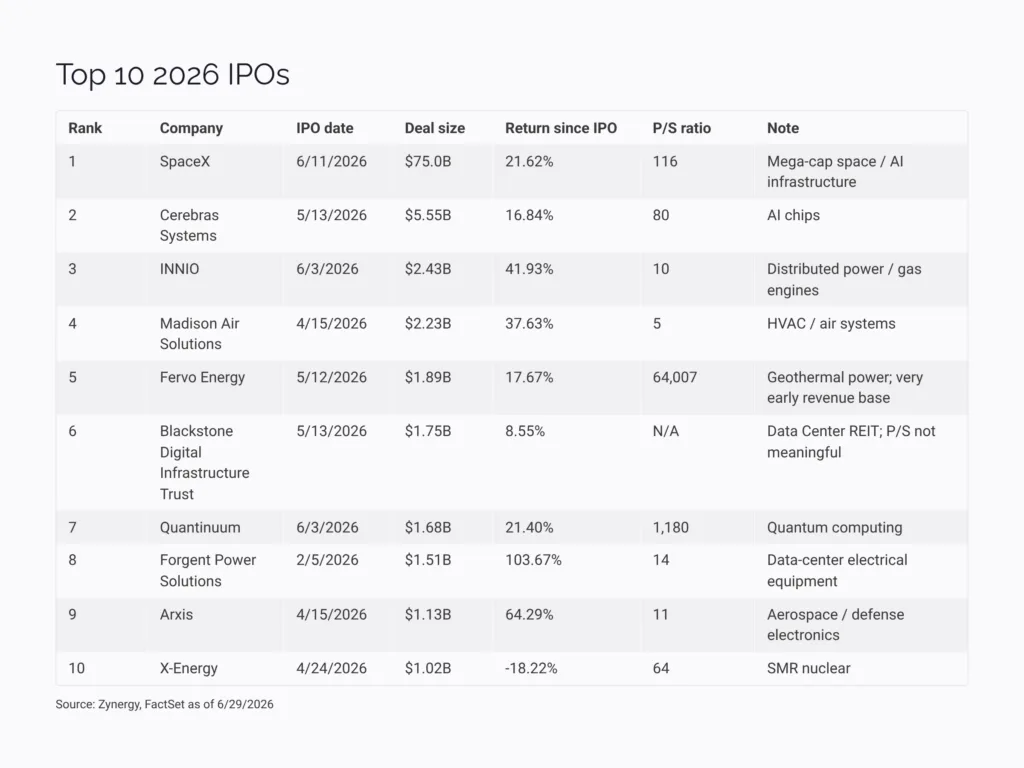
SpaceX has already tested public market demand. Reuters reported that SpaceX planned to raise a record $75 billion at a $1.75 trillion valuation, and later reported that short interest rose after the company’s June 12 market debut and subsequent share volatility.
Other potential mega-IPOs, including OpenAI and Anthropic, remain closely watched by investors because they could test public market appetite for frontier AI at unprecedented scale. Reuters has described the potential wave of SpaceX, Anthropic, and OpenAI listings as a major liquidity and risk-appetite test for the second half of 2026.
Zynergy’s Post-IPO Framework: Moat, Valuation, Structure
Zynergy’s approach to post-IPO investing comes down to three questions.
1. Does the company have a real moat?
A moat is not branding. It is a defensible advantage that can survive competition, capital cycles, and public-market scrutiny.
SpaceX is a clear example of a company with strategic depth. It combines launch capabilities, Starlink distribution, government and defense relationships, engineering talent, and a scale advantage that few competitors can easily replicate. Morningstar noted that Starlink became a major revenue engine, while launch and satellite operations create a platform that looks more like vertically integrated infrastructure than a single-product company.
But a moat alone does not make a stock attractive at any price.
2. Is the valuation reasonable?
This is where discipline becomes essential.
We are cautious that some newly public companies with nascent revenue are trading at extreme price-to-sales multiples. Multiple companies are currently trading at price-to-sales multiples over 1,000. At some point you move beyond speculation and are approaching “crazy.” Even SpaceX, despite its operational quality, screens as expensive. Public estimates tied to its IPO valuation suggest a price-to-sales multiple well above 100, depending on the revenue base used.
Investors have seen this movie before. Tesla sustained elevated valuations for years, partly because investors assigned value to Elon Musk’s ability to create new markets, reshape narratives, and attract capital – this is the “Musk factor.” It is real. It can keep valuations elevated longer than traditional models expect.
But the existence of a narrative premium does not eliminate downside risk.
3. What does the structure tell us?
IPO structure often receives less attention than growth projections. It should not.
SpaceX’s IPO highlighted why. SpaceX’s public float at IPO was approximately 4%. This is one reason SpaceX was not included in the S&P 500, which requires a minimum 10% free float. FTSE Russell has historically maintained a less stringent 5% threshold but opted instead to re-write their rules to accommodate mega-caps like SpaceX.
That limited float can create artificial scarcity. When only a small percentage of shares is available to trade, demand can push prices far above levels that might prevail once more supply enters the market.
Lockups add another layer. Elon Musk is required to hold his SpaceX shares until June 12, 2027. With Elon holding roughly 42% of SpaceX shares, even a gradual block-release next year could have a meaningful impact.
For Zynergy, that creates a clear overhang. As float expands, scarcity premium can dissolve. That does not mean SpaceX must fall. It means the return profile changes.
In IPO investing, excitement is not a strategy. Structure, valuation, and competitive moat decide whether scarcity becomes opportunity or risk.
Why Zynergy Is Avoiding SpaceX for Now
SpaceX may be one of the most important companies to enter the public markets in years. It also may be a poor post-IPO entry point today. Zynergy’s current stance is to avoid SpaceX at this stage because the risk-reward balance is not compelling enough. The moat is impressive. The valuation is demanding. The structure is restrictive today and potentially dilutive to scarcity over the next year. Key concerns include:
- Low public float at IPO, creating an artificial scarcity premium
- High price-to-sales valuation, even for a category-defining infrastructure platform
- Major lockup expirations that could materially increase tradable supply
- Heavy narrative dependence on the Musk factor
- Potential volatility as investors recalibrate from scarcity pricing to fundamental valuation
This is not a rejection of SpaceX as a company. It is a rejection of the current setup as an investment entry point.SpaceX raised a record $75 billion at a ~$1.75 trillion valuation, with short interest recently spiking as high as 13% not long after its June 12th market debut.
The Bigger Lesson for Investors
The 2026 IPO market is telling us something larger about capital allocation.
Investors increasingly want exposure to private-market innovation, especially AI, defense, space, and infrastructure. At the same time, the best assets are coming public later, larger, and with more complex structures.
For family offices and sophisticated investors, the playbook should be disciplined:
- Underwrite the business, not the brand
- Analyze float, lockups, and index inclusion mechanics
- Separate scarcity premiums from sustainable value creation
- Favor companies with durable moats and credible paths to margin expansion
- Be willing to wait when price and structure do not align
The IPO market is improving. But improvement is not the same as indiscriminate opportunity.
Zynergy’s view is simple: the next cycle of innovation investing will reward investors who combine imagination with structure. AI, space, defense, and digital infrastructure may define the next decade of capital formation. The winners will not be those who chase every debut. They will be those who understand when innovation is investable and when excitement has outrun discipline.
2 Major Takeaways:
- Public market in the US is very healthy and experiencing explosive earnings growth with reasonable valuations in aggregate. We’re starting to see some broadening beyond tech/AI the last couple of weeks.
- IPO market in 2026 is characterized by fewer IPOs but larger deal size vs. last year. Structure and valuation is important, not just hype (some IPOs are trading > 1,000 Price to Sales).